Introduction to Production Management
This page introduces the fundamentals of production management, exploring production workflows, the essential tasks involved when taking on the project manager’s role, and specific project management methodologies used across various industries.
Last week, you may have received access to the chapter “Translation and localization project and process managers” by Alaina Brandt, shared with you privately in keeping with fair use provisions defined in U.S. copyright law. Please do not share this resource outside of our class.
The first two sections of today’s lesson draw from that chapter. Students interested in learning more are encouraged to read the complete chapter.
Production Workflows
Understanding workflows is essential because you cannot effectively manage what you do not understand. Before we can optimize processes, control quality, or troubleshoot problems, we must first comprehend how work flows from one stage to the next, what inputs each stage requires, and what outputs each stage produces. This understanding allows managers to identify bottlenecks, strategic points for quality control, and opportunities for efficiency improvements.
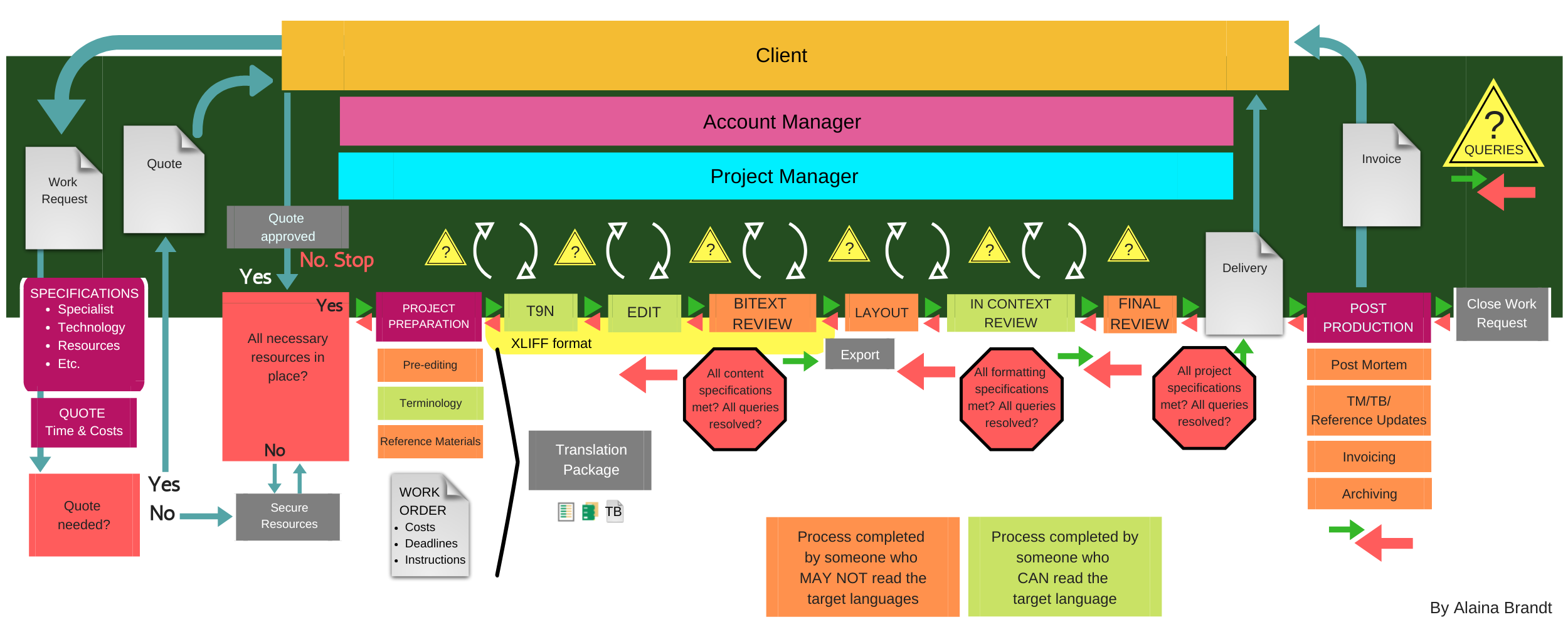
A production workflow is a continuous series of planned actions that connect the initial work performed to produce content with the final activity that results in the finished product or service. The image above presents a translation production workflow, in which work is scoped and then quoted, prepared and then run through TEP (translation, editing, proofreading), and finally formatted, reviewed and delivered.
To generalize from this workflow, production management begins with establishing clear project requirements (as you learned last week). Once these requirements are defined, the process involves planning out sequential steps to meet project objectives. When we apply quality management standards like ISO 9001 (which we’ll explore more next week) to any production workflow, we understand that the workflow represents a continuous series of actions connecting the initial work that produces content requiring processing and the activities that will result from producing the finished product.
Process optimization involves sequencing required actions so that production can be carried out as efficiently as possible. Each process functions as an input-process-output (IPO) chain where:
- Input: Work product from the previous step
- Process: The current step that transforms the input
- Output: New deliverables that must be verified for accuracy and completeness and become the input for the next step.
The key to effective workflow sequencing lies in knowing when to incorporate quality control checks. Quality control should be strategically placed at points where detecting certain types of errors will be most beneficial and prevent costly rework downstream.
Workflow optimization requires synthesizing multiple information sources, maintaining attention to detail, and exercising patience. It’s a dynamic task that must consider many dependencies and can only be achieved through iterative improvement over time.
Reflection Questions
-
How does the input-process-output model apply to industries beyond translation and localization? Provide a specific example.
-
Why do you think quality control checks are more strategic at certain points in a workflow rather than others?
-
What challenges might arise when trying to optimize a workflow, and how could teams address these challenges?
The Project Manager’s Hat
The Project Management Institute (PMI) provides foundational definitions that apply across all industries. A project is defined as a “temporary endeavor undertaken to create a unique product, service, or result,” while project management is “the application of knowledge, skills, tools, and techniques to project activities to meet project requirements” across five key areas: initiating, planning, executing, monitoring and controlling, and closing projects. The project manager (PM) serves as “the person assigned by the performing organization to lead the team that is responsible for achieving the project objectives.”
Project management extends beyond being merely a profession—it’s a crucial life skill. Everyone manages multiple competing projects simultaneously, whether they consciously recognize it as project management or not. In translation and localization contexts, project management tasks are distributed across all team members: translators, quality managers, engineers, and others all perform PM duties alongside their operational work.
These professionals handle project management responsibilities such as:
- Submitting and responding to queries
- Monitoring and reporting on deadlines and progress
- Coordinating with team members
- Managing resource allocation
Meanwhile, dedicated project managers focus on delivering overall project requirements and objectives on behalf of and in collaboration with their project teams. In the translation and localization industry, a PM’s job responsibilities may include:
- account management
- product management
- assigning work based on specialization and capacity
- managing and documenting change
- monitoring key performance indicators
Reflection Questions
-
In what ways do you already practice project management in your personal or academic life? Provide specific examples.
-
How does the distributed nature of project management responsibilities (where everyone on a team has PM duties) compare to having a single dedicated project manager?
-
What skills do you think are most important for someone wearing “the project manager’s hat,” and why?
Project Management Methodologies
Different industries and organizations employ various project management methodologies depending on their specific needs, project types, and organizational culture. Here are four prominent methodologies:
| Methodology | Key Characteristics | Best Used For |
|---|---|---|
| Waterfall | Sequential, linear approach with distinct phases completed in order; changes are difficult once a phase is complete | Projects with well-defined requirements, regulated industries, construction, hardware development |
| Agile Project Management | Iterative approach with short sprints, continuous feedback, and adaptability to change | Software development, creative projects, environments requiring flexibility |
| Six Sigma | Data-driven approach focused on eliminating defects and reducing variation in processes | Manufacturing, quality improvement initiatives, process optimization |
| Lean Model | Emphasizes waste reduction, value stream mapping, and continuous improvement | Manufacturing, service industries, any process-focused environment |
| Kanban | Visual workflow management using boards and cards to track work progress | Task management, continuous workflows, teams needing visual project tracking |
Research Activity
For this week’s discussion, research one of the methodologies listed above (or another project management methodology of your choice) and create a post addressing the following:
- Which methodology do you find most appealing and why?
- Share a resource about the methodology you explored. What did you learn from the resource?
- How does this methodology work in practice?
- What are the main pros and cons of this approach?
- In what type of work environment do you think this methodology would be most effective?
Getting Started Resources:
- What is Agile Project Management (APM)?
- Six Sigma and Lean Model of Project Management
- Kanban and its purpose in project management?
Feel free to explore additional methodologies such as Waterfall, Scrum, or others that interest you.
📥 Download this Content
Find this file on our repo and download it.
🤖 GAI Study Prompts
Copy the downloaded content and try it with these prompts:
- “Explain the input-process-output model with examples from different industries.”
- “Compare Agile, Six Sigma, Lean, and Kanban methodologies for [specific project type].”
- “Quiz me on production management concepts and project management definitions.”
- “Tell me how I can become a successful project manager.”
- “What are the top 5 concepts/skills that a production manager needs to know?”
Next Activity: Project Management